"Show me yours, I’ll show you mine."
"Show me yours, I’ll show you mine."

It is a cheeky quip. For those of us over 50, it lands like a nervous dermatology check-in—asking the doctor, half-joking, if "this mole looks suspiciously off."
But in today’s business landscape, we aren’t looking for skin imperfections (well we are but that’s besides the point). We are looking for a different kind of Mole. We share information now more than we ever have. The dynamic has shifted because the conversation is no longer just between people; it is between people and Large Language Models (LLMs) that peel back the layers of our industries.
For example, when you engage an LLM regarding a lawsuit, a standard prompt won't suffice. You must engineer the persona. One might say: "I need you to think like a senior partner at a renowned employment law firm who specializes in class action lawsuits and understands who the key players are in this specific county. I also need you to develop a PR strategy to mitigate issues based on the following SWOT analysis. Please assess the risks and opportunities. Put your Partner Persona hat on."
But even this is too high-level. Simply providing this prompt, along with copies of emails and text messages, isn’t enough to alert the system to the environmental landscape. It misses the trade issues, the politics between businesses and the public, the directionality of where the market is evolving, or the emerging disruptive forces.
All of that insight is at our fingertips, but it has become a game of how well you can interrogate the system.
The Rise of the Mole (the informant, not the one on your skin)
Suffice it to say, now more than ever, it is time for intelligent consolidation and partnership—but not in the way we’ve seen before. It is about finding the Mole.
These are the key informants who understand the market driving forces. These are the people inside the room following the strategic "big bets" being made by large players who, coincidentally, usually have the most assets to lose and remain diligent in protecting them. Just look at how the Sitzer case is being appealed; watch how parties have flip-flopped sides in a dizzying game of musical chairs.
Confidentiality is becoming the greatest of luxuries. With cyber claims on the forefront and the risks so high, costs will inevitably trickle down into our businesses. Your secrets, your "secret sauce," and your strategic approach are now premium assets, especially as you activate distinct strategies in this spring market.
The Marketing Parallels: Am I Overthinking It? No!
One thing remains constant: Preparation.
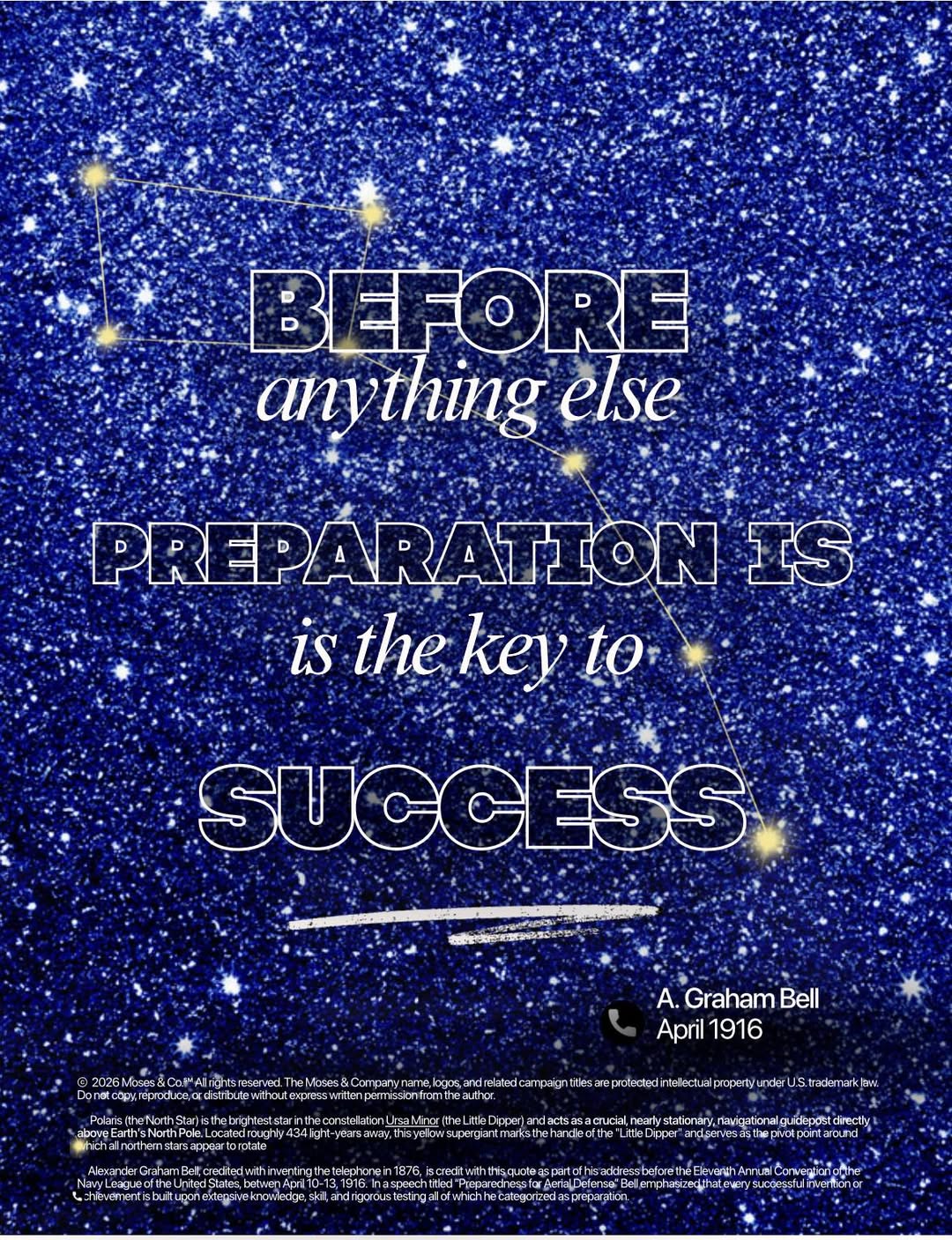
I have quoted Alexander Graham Bell so often in my business and former corporate life, that it has become foundational DNA: "Before anything else, preparation is the key to success."
It is f*ing brilliant because it draws the dotted line to exactly why I can say Dreams Become Reality. It is the backbone of my campaign. Look at the syntax: it beautifully starts with the word Before. Meaning Pre-. Meaning literally ahead of the event.
People (especially past brokers) often tell me, "Don't overthink it." And I always have to stop and ask: “Am I overthinking it? Or are you just underthinking it?"Because when you look at the market, most people are underthinking it. Confirmation bias rich with statements like why reinvent the wheel when there’s a model for that? Or when you insist on accelerating your learning path only to hear can’t hurry love. How convenient.
As we count down to Super Bowl Sunday—bracing for the Seahawks vs. Patriots showdown and the inevitable polarity of the much-hyped (and likely equally hated) Bad Bunny halftime show—we participate in our true national religion.
It is a magical, bizarre anomaly in advertising: the one time a year we voluntarily come to the screen expecting to be sold to. As humans, we let our guard down. We harbor an experiential, emotional expectation of the flow. From the jarring suddenness of Scientology commercials to clever product placements, brands come alive. Some attempt to reinvent themselves with billions in spend—hello, Homes.com—only to shift gears later as the marketplace matures.
It is not unlike the fantasy we create for our homebuyers at open houses. We stage the scene to generate demand—or "competitive forces," as my high school Econ teacher Mrs. Berryhill would remind us, because that is what actually drives price.
Ultimately, whether it is a 30-second spot or an Open House, you run out of time. Deadlines hit. The commercial goes live. As a team, you have to agree that this version is how you maximize audience engagement and the Call to Action (CTA).
The Real Estate Reality Check
The same is true for the broader industry. We cannot be transactional in the old way of thinking, as much as we want to be "on the inside." Something big is here. AI is a permanent person in every one of our rooms: everywhere we work, live, and play. And it is accelerating faster than any technology we’ve seen before.
It is no longer about getting to the right answer. It is about getting there first. And then, getting there first with a higher quality answer.
Generation Z is right to be skeptical and apprehensive about advertising. Trust is no longer blind because we can now vet the quality of answers. We can attribute whether claims hold water relative to performance. "We are Number One" is no longer a good enough claim—even if substantiated by "As Awarded By"—when you dig deep. We can now see how numbers are managed or reallocated by brokers trying to create the appearance of high-performing agents.
But there is a quieter, sharper reality emerging in the data. While the local 'Yale or Jail' quip is jarring, it bluntly captures the divergent realities parents are navigating right now. Many are still opting for Montclair because its safety, walkability, and genuine diversity remain unrivaled, even despite the public school district’s paralysis over a $20 million budget shortfall. We are seeing a strategic behavior emerge: families are buying the town for the lifestyle but effectively purchasing an insurance policy on their children's future by 'stacking' an MKA education on top. The school's fully capitalized Renaissance—visible in new facilities and 'Ivy Plus' matriculation—has turned tuition from a luxury into a calculated necessity for those who want the Montclair ethos without the district’s instability.
On the surface, these seem like benign preferences. But make no mistake: these are not just filters on a search engine. They are strong indicators of a fractured landscape. "Safe enough" has become the highest form of luxury. It implies that the baseline of the world is chaos, and the wealthy are paying a premium for insulation. If you don't understand the sociology behind those specific words, you aren't even playing the game.
The data speaks for itself. According to NAR:
• Top 4%: Agents who did 10–19 deals in 2025.
• Top 7%: Agents who did 5–9 deals.
• The Reality: Over 70% of agents did zero.
So, when you look at that number, what do you see? Does that sound like a well-oiled machine focused on quality, or does it sound like a massive vulnerability waiting to be exploited?
How you answer that question tells me everything about your strategy. It reveals whether you are managing backward—trying to protect a broken model—or managing forward, ready to take ground.
It draws the line between playing defense to survive the past, and playing offense to capture the future.
Which game are you playing?
