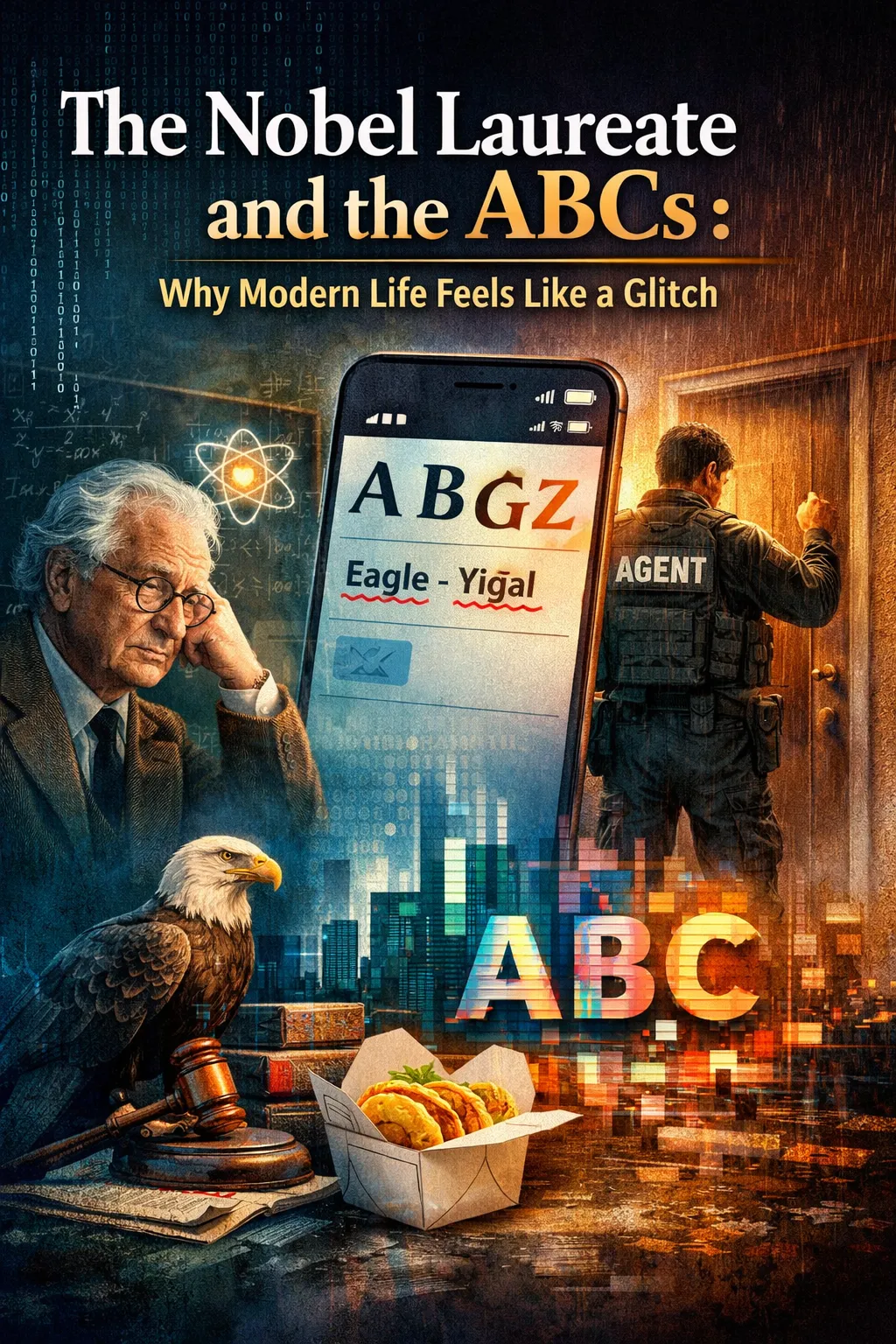
The Nobel Laureate and the ABCs: Why Modern Life Feels Like a Glitch
The Nobel Laureate and the ABCs: Why Modern Life Feels Like a Glitch

It was the best of times, it was the worst of times. It was the age of wisdom, it was the age of foolishness.
Dickens wrote that about the French Revolution, but he might as well have been writing about my iPhone.
We are living through a bizarre technological paradox. On one hand, I have access to "God-like" intelligence in the cloud—Large Language Models (LLMs) capable of structuring complex legal arguments and saving me tens of thousands of dollars in retainers.
On the other hand, the voice-to-text on my phone—the "edge" intelligence I rely on 50 times a day—can’t tell the difference between a majestic bird and a proper name. Every time I say "Eagle," it insists on writing "Yigal." Every time I say "Tsuris" (which is exactly what this gives me), it writes "Taurus."
It feels like I hired a Nobel Prize-winning physicist to tutor a kindergartner. When I ask them to solve a complex theorem, they are brilliant. But when I ask them to sing the ABCs, they get bored, overthink it, and trip over the letter "L"—much less wondering if by the time they make it to the end of the song they’ll say "Zee" or "Zed."
They are so deep in thought solving string theory that they don’t realize they are standing in the rain without an umbrella. And that is the state of our union: We have genius tools, but we are still soaking wet and tripping over the alphabet.
The "Slap Shot" Reality
This disconnect isn't just in our phones; it’s in our politics.
We just watched the Super Bowl, a celebration of "Fair Play" and clear rules. But step outside into the real world—specifically here in New Jersey during a special election—and the rules have been replaced by the plot of the 1977 movie Slap Shot.
Political strategists have realized that "Clean Hockey"—policy, nuance, centrism—doesn't sell tickets. It doesn't put butts in seats or voters in booths. So, they bring in the "Hanson Brothers." They goon it up. They mudsling. They polarize.
Why? Because the "Base" is addicted to the fight, not the outcome. The unifying crowd stays home, bored or disgusted by the violence, while the disruptive crowd shows up, activated by the promise of a brawl. It’s a fractured promise, leaving us to wonder: Is anyone actually playing the game to win, or just to keep the fight going?
The Glitch at the Door
This "glitch in the system" feeling hit me hardest last August, right at my own front door.
I live in a high-rise. I live the "Smart City" life where a knock on the door usually means sustenance—tacos, Costco, Amazon. So when I heard a knock, I opened it. I didn't ask "Who is there?" because I live in a world where systems are supposed to work.
Instead of a delivery driver, I was face-to-face with a man in a tactical vest that just said "AGENT."
He wouldn't give his name. He didn't hand me a card. He was likely a private investigator or a "fixer" sent during the heat of a high-stakes dispute—a scare tactic dressed up in a Spirit Halloween costume of authority.
And in that moment, I froze. My survival brain took over. "Yes sir, no sir." I reverted to the primal instinct of de-escalation.
Later, a lawyer friend asked me, "Why did you open the door?"
It felt like victim-blaming. It implies I should live in a constant state of paranoia. But I opened the door because I’m a civilized person living in a civil society. I opened the door because I refuse to let fear run my life. The fact that I expected my groceries was a sign of sanity. The fact that he was there was the glitch.
The "Costco Defense"
That moment—the "Costco Defense"—is where I found my power.
They wanted me to be paranoid. They wanted me to be scared. Instead, I realized the absurdity of it all. It was dark comedy. It was a scene from a Coen Brothers movie, where the villain is just a guy in a polyester vest trying to intimidate someone who has already outsmarted him.
Because here is the twist: While the old world was playing "Slap Shot" with scare tactics, I was playing "Moneyball" with AI.
I used those Large Language Models—the "Nobel Laureates"—to organize my evidence and structure my strategy. I built a framework so strong that the "barrier to entry"—the expensive legal retainers that usually keep people like me out of the game—disappeared. Suddenly, the dynamic shifted. I wasn't just a participant in the system; I was navigating it on my own terms.
I had de-risked the asset. I had reverse-engineered the game.
Fair is Fair
So, where does that leave us?
We are stuck in the middle. We have phones that can't spell, politics that feel like a brawl, and occasional knocks at the door that stop your heart.
But we also have tools of incredible power at our fingertips. We have the ability to organize, to strategize, and to fight back against the "goons" without ever throwing a punch.
I’m still going to get "Yigal" when I want "Eagle." I’m still going to get mudslinging mailers. But I’m not going to let the glitches break me.
I’m going to keep opening the door. Because I’m still expecting my tacos. And if it’s a glitch instead? Well, I’ve got an app for that too.
Fair is fair.
Author's Note: Copyediting this was the ultimate "Q.E.D." (Quod Erat Demonstrandum) moment. Living the proof of my own blog while writing it. So, if you spot a typo, a missing comma, or a sentence that sounds like I’m having a stroke (like "mistake mistakes"), please don't blame me. Blame the Nobel Laureate in my pocket who is currently too busy solving string theory to realize I asked for a period, not the word "period."
